

Best Water Temperature for Matcha: How to Adjust Around 80°C
Supervised by Wakimoto Jokoen Co., Ltd. — Uji tea manufacturer, Kyoto
Share
Hello from ICHIZEN. If you have ever wondered what temperature your water should be for matcha, you are not alone.
A helpful place to begin is around 80°C. It is not the only correct answer, but it gives you a calm starting point for adjusting aroma, bitterness, foam, and overall drinkability to your own taste.
Why 80°C is a useful starting point
Japanese public household guidance from the Ministry of Agriculture, Forestry and Fisheries introduces matcha with a guideline of about 80°C water and 2 g of matcha. For everyday preparation, that is a reassuring baseline.
ICHIZEN’s matcha is Kyoto Uji matcha, selected and refined by Wakimoto Jokoen. Because it is machine-milled into an ultra-fine, uniform powder, small changes in water temperature and quantity can feel quite noticeable in the cup.
If you would like to review the full preparation flow, you may also find our step-by-step guide to making matcha helpful.
How temperature changes aroma, bitterness, and softness
As a sensory guideline, using cooled water around 80–90°C makes the differences easier to notice. A slightly higher temperature often brings out more aroma, but bitterness and astringency can also stand forward. A lower temperature may feel softer and gentler.
| Water temperature | What you may notice | When to try it |
|---|---|---|
| Around 70–75°C | Softer, with bitterness feeling more restrained | When you want a mellow cup |
| Around 80°C | A balanced starting point for aroma and ease of drinking | When you are comparing temperatures for the first time |
| Around 85–90°C | Aroma may rise more clearly, with bitterness also more noticeable | When you prefer a more defined taste |
This is not a statement about medical effects or ingredient quantities. It is simply a practical tasting guide. If your matcha tastes too bitter, temperature is only one possible reason; our article on why matcha can taste bitter may help you narrow it down.
If you do not have a thermometer, cool the water gently
Using water straight from a boil can make the aroma vivid, but it can also make bitterness more noticeable. Without a thermometer, try letting the water settle before it touches the matcha.
- Pour boiled water into another vessel first.
- Wait briefly before adding it to the matcha bowl.
- Use a thermometer when you want repeatable results.
It is best not to say that one transfer always lowers the water by a fixed number of degrees. The vessel, room temperature, and water volume all matter. Your own kitchen conditions will teach you more accurately over time.
For repeatability, keep the bowl and measurements the same
A pre-warmed bowl and a cold bowl will not behave the same way. On a cool morning, a cold chawan can lower the actual water temperature faster than you expect.
If you want to compare carefully, keep the same bowl, matcha amount, and water volume, then test in 5°C steps. If you are unsure about quantity, decide that first with our guide to how much matcha to use per cup.
For example, prepare 2 g of matcha at 80°C first. Then try 75°C and 85°C on another day. The cup that feels most comfortable to you is a good answer for that moment.
A few safety notes when handling hot water
Even after cooling, hot water can still burn. Please handle bowls, pitchers, and kettles with care.
If you heat water in a microwave, be aware of sudden boiling or superheating. Also, do not put boiling water into a sealed container and shake it. Pressure can build and cause an accident.
In short: begin at 80°C, then adjust for yourself
For matcha water temperature, 80°C is a steady place to begin. Go slightly higher when you want more aroma and definition; go slightly lower when you want a softer cup.
You do not need to find the perfect number at once. Try small adjustments with the same bowl and measurements, and let your taste guide you calmly.
Public references consulted: Ministry of Agriculture, Forestry and Fisheries, “Types of Tea: Taste Characteristics and Brewing Points”; Ministry of Agriculture, Forestry and Fisheries, “Special Feature 2: Matcha”; Japan Tea Central Public Interest Incorporated Association, “Japanese Tea Introduction Pamphlet.”
FAQ
How can I get close to 80°C without a thermometer?
Pour boiled water into another vessel and let it rest briefly before using it. The exact drop depends on the vessel and water volume, so use a thermometer if precision matters.
Is water temperature the only reason matcha tastes bitter?
No. Bitterness and astringency can also change with the amount of matcha, water volume, whisking, and freshness. Start around 80°C and compare with consistent measurements.
Can I make matcha with boiling water?
You can drink matcha made with very hot water, but water just off the boil may make bitterness more noticeable and requires care to avoid burns. Cooling it slightly is often easier to drink.
Does water temperature matter for iced matcha too?
Yes, it can. Cold water alone may not disperse the powder smoothly. Making a small paste with water around 80°C before adding ice, cold water, or milk can reduce clumps.
Column
Related Articles
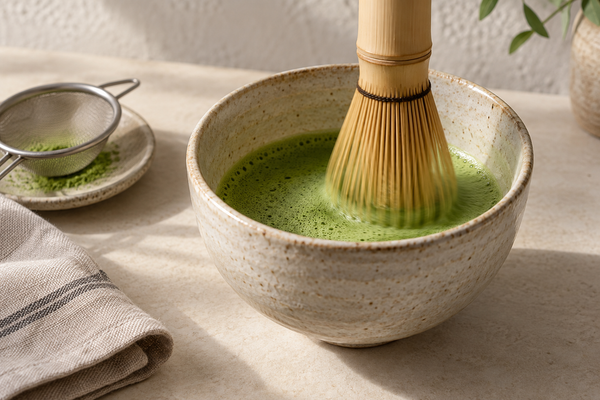
Why Whisk Matcha in an M Motion? A Smoother Bowl Step by Step
A beginner-friendly guide to the matcha whisk “M” motion: what it really means, how it helps loosen clumps and create...
Read More →
Why Do You Turn a Matcha Bowl? The Meaning Behind the Etiquette
A calm guide to why guests turn the matcha bowl in a tea gathering, focusing on the bowl’s front, respect between hos...
Read More →
What Is Single-Origin Matcha? How It Differs from Blended Matcha
Single-origin matcha is not an official grade. It is a descriptive term that may refer to region, farm, cultivar, har...
Read More →