Hello from ICHIZEN. If you enjoy matcha often, you may naturally wonder how many calories are in one cup.
The short answer is simple: plain, unsweetened matcha is very low in calories when you look at the amount of powder used for one serving. A matcha latte, however, should be considered separately because milk and sweeteners add their own calories.
How many calories are in matcha powder?
According to the Standard Tables of Food Composition in Japan 2020, matcha tea powder is listed at 237 kcal per 100 g.
If you use 2 g of matcha for one cup, that comes to about 4.7 kcal by simple calculation: 237 ÷ 100 × 2 = 4.74 kcal. For many people, that is lower than expected.
Please use this as a general reference. In practice, the nutrition label on your specific product should come first, as values may vary slightly depending on the product and labeling method.
If you are still finding your preferred strength, our guide to how much matcha to use per cup may help. Starting around 2 g is a gentle way to understand both flavor and serving size.
Plain matcha and matcha latte are not the same
When thinking about matcha calories, the most helpful question is this: are you drinking only matcha and water, or are you adding milk and sweetness?
Unsweetened matcha
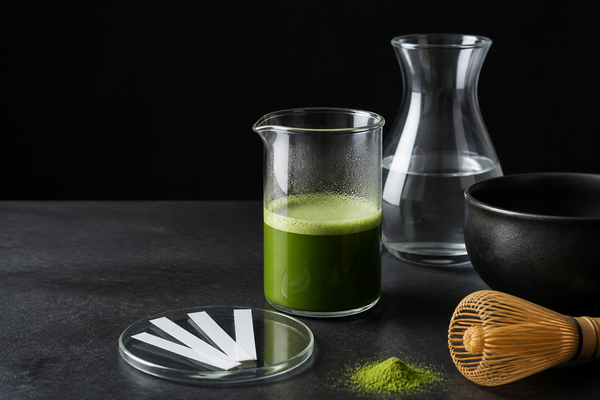
When matcha powder is whisked with hot water, the calories mainly come from the powder itself. Using the reference above, 2 g is about 4.7 kcal.
Because there is no added sugar, you can taste the aroma, umami, and gentle bitterness of the tea more clearly. It is a good choice when you want a clean, simple cup.
Matcha latte
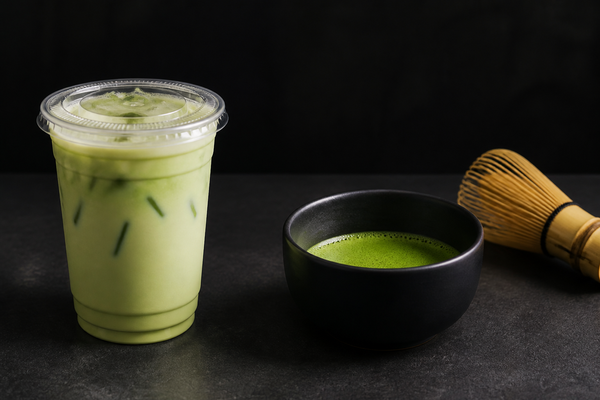
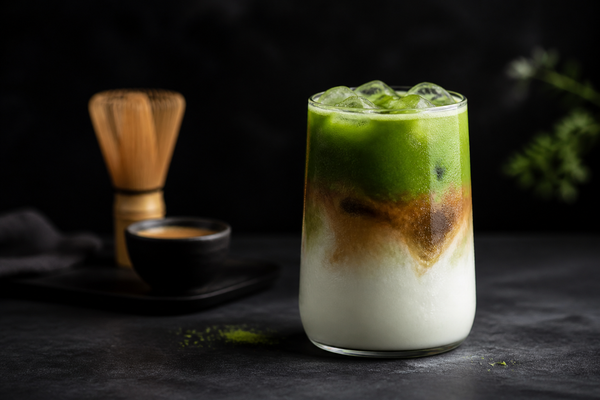
A matcha latte includes the matcha powder plus milk. If you add sugar, syrup, honey, or a sweetened milk alternative, those calories are added too.
So the calories in a matcha latte depend much more on the milk and sweetener than on the matcha itself. Dairy milk, soy milk, and oat milk also change the texture and taste. If you are choosing a milk, you may enjoy our guide to the best milk for matcha.
What about nutrition and fiber?
The same Japanese food composition tables list matcha at 38.5 g of dietary fiber per 100 g. Converted to a 2 g serving, that is about 0.77 g.
This reflects one of matcha’s characteristics: you consume the finely milled tea leaf itself. Still, it should not be seen as a replacement for vegetables, beans, grains, or other fiber-rich foods. It is better understood as a small addition within an overall varied diet.
For a broader view, you can also read our calm introduction to the health-related qualities of matcha. We prefer to look at matcha as a thoughtful daily habit, without making medical promises.
Small labeling details to check
When comparing products, take a moment to check the serving basis on the label.
Is the value shown per 100 g, or per serving?
Is it pure matcha powder, or a latte mix?
Are sugar or milk ingredients already included?
How many grams do you actually use in your cup?
Sweetened matcha powders and latte bases can be very different from pure matcha powder. Even when the front label says “matcha,” the ingredient list will tell you much more.
Enjoying matcha in a way that fits you
ICHIZEN’s matcha comes from Kyoto Uji and is selected and refined by Wakimoto Jokoen, a fourth-generation green-tea wholesaler in Ide-cho, Kyoto, with tea-judging expertise developed through the Kyoto tea evaluation tradition.
Our matcha is machine-milled into an ultra-fine, uniform powder for a smooth texture, whether you prepare it with water or as a latte.
Knowing the calories is not about restricting your enjoyment. It simply helps you choose the cup that suits the moment: plain and clear today, soft with milk tomorrow. Please enjoy matcha in the way that feels natural in your daily life.
FAQ
Can I drink matcha every day?
For most people, matcha can be enjoyed as a daily food in moderate amounts. If you are sensitive to caffeine, consider adjusting the amount or the time of day.
How much is 2 g of matcha in teaspoons?
As a rough guide, 2 g of matcha is about two bamboo scoops, or a little less than one level teaspoon. For accuracy, weighing the powder is best.
How can I make a lower-calorie matcha latte?
Use unsweetened matcha powder, then adjust the amount and type of milk and whether you add sweetener. Keeping sugar separate makes it easier to control.
Can matcha fiber replace vegetables?
Based on food composition data, 2 g of matcha contains about 0.77 g of dietary fiber. It can be a small addition, but not a replacement for varied fiber-rich foods.